Projects
Things I've built
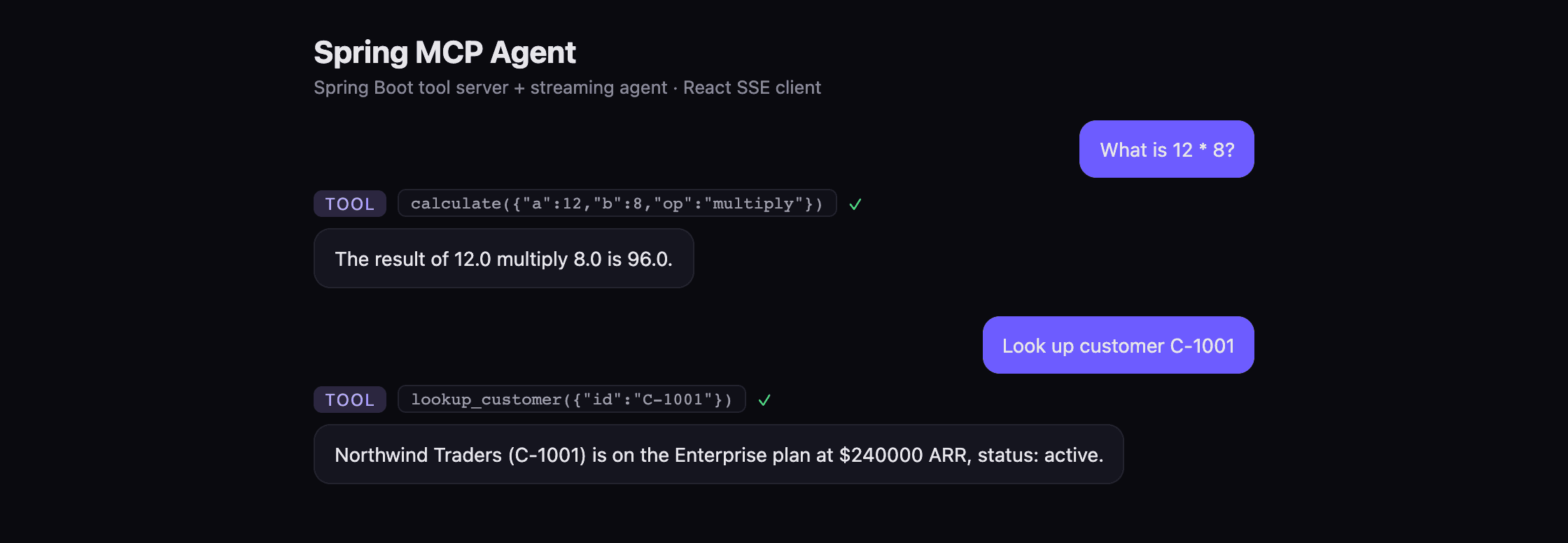
Spring Boot MCP Agent
A full-stack agentic developer tool: a Java 21 / Spring Boot backend publishes its tools as an MCP server over Streamable HTTP, so any MCP client can connect, and runs a streaming agent on the same tool registry, with a React + TypeScript front-end that renders tool calls and tokens in real time over SSE. Includes an OpenAI-compatible /v1/chat/completions endpoint, a JUnit suite, and a CI check against the Java and TypeScript MCP clients.
Live demo is on a free tier and cold-starts, so first load can take 30 to 60 seconds to wake.
MCP Integration Server
Enterprise MCP server exposing 6 agentic tools over both stdio and Streamable HTTP transports, built as both a producer of tools and a consumer of the protocol. The live demo runs a Claude agent as a real MCP client: it discovers tools at runtime over the protocol, then calls them to handle customer lookups across 5 accounts, surface support tickets, search a 5-document knowledge base, and retrieve business metrics ($5.8M ARR, 1,340 accounts), all from fictional sample data. The demo is a separate Next.js app serving the same tools over MCP, with an Origin check and a labelled fallback when the model is unavailable.
Demo app source: Gramman87/mcp-web
Streaming Analytics Dashboard
A full-stack Next.js dashboard over fictional SaaS metrics: MRR/ARR, churn, and engagement charts, with two Claude integrations on top: a natural-language query interface that streams answers token by token, and server-side cached insight cards. Both fall back to labelled rule-based answers when the model is unavailable, so the page never goes blank.
Portfolio Analyst Sub-Agent System
A Python lead orchestrator (Claude Sonnet 4.6, adaptive thinking) dispatches to three specialist sub-agents (Claude Haiku 4.5) via tool-use (market data, news sentiment, risk concentration), then synthesizes their briefings into a decision-grade analyst memo. Sub-agents run concurrently, portfolio math is computed in code, and the UI reports token use across every model call. Includes a Claude-as-judge evaluation harness scoring routing, coverage, and quality on hand-written cases, run on demand, plus offline tests in CI and a labelled rule-based fallback when the model is unavailable.
HR Operations Agent
A Claude tool-calling agent for HR operations over a fictional company of 30 employees, 6 departments, and 7 policies. The agent chooses from 8 tools for compensation analysis, retention risk scoring, org-chart traversal, PTO tracking, and policy search, and the UI shows each tool call with its result. When the model is unavailable, keyword rules pick the same tools and the answer is labelled. Full-stack Next.js / TypeScript, live and open-source, with tests in CI.
RAG Knowledge Agent
End-to-end RAG over a documentation corpus: TF-IDF cosine retrieval (smoothed IDF weighting, cached per-chunk vectors) surfaces the top-k chunks with relevance scores, then Claude composes a grounded answer with inline source citations. The retrieve-then-generate pattern behind enterprise knowledge assistants. Both halves are real, no mocks.
Flightplan: Release Roadmap & Milestone Audit
A release-roadmap and milestone-audit web app I built and shipped on my own initiative for a 19-team SAFe program at Accenture Federal Services, giving scrum masters and the release train engineer one view of what each team is releasing, when it reaches production, and what it depends on. A 20-rule audit engine reads GitLab milestones, issues, and merge requests and flags mis-entered release data, linking each finding back to GitLab for correction. It runs entirely in the browser with OAuth 2.0 PKCE sign-in and read-only access as the signed-in user, so there are no service credentials to manage. Built in TypeScript, React, and D3, with 87 tests over the domain logic.
Work project · no public repo